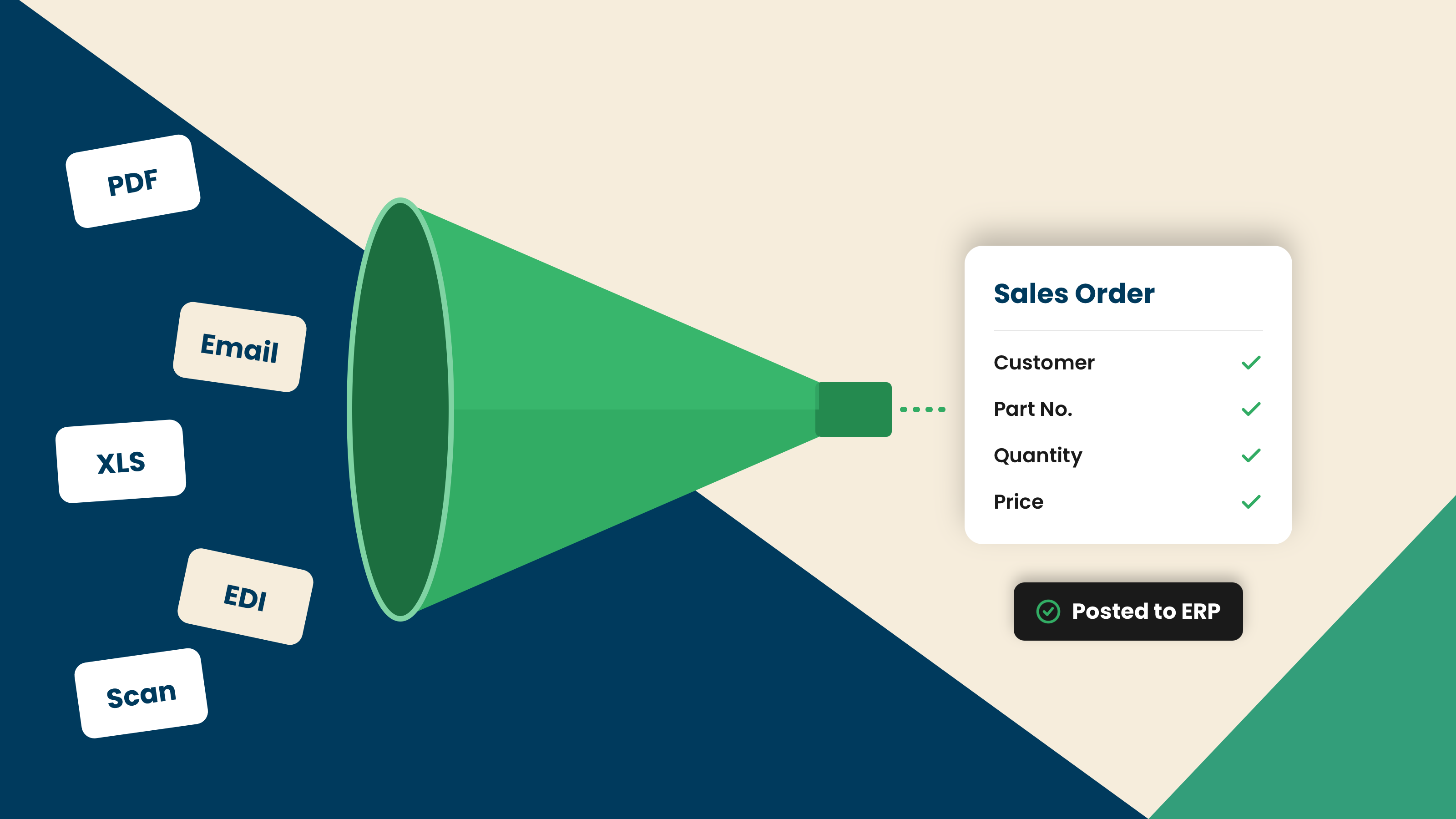
AI order processing uses artificial intelligence to turn every inbound order, whatever its format, into validated, system-ready data. The technology reads each order, interprets its header and line items, checks them against your ERP master data, and posts clean orders automatically while a person reviews only the exceptions it flags.
This guide is the hub for our AI order processing coverage. It explains what the term means for business teams, how the technology works, which order formats it handles, and the one question that separates a genuine solution from a faster inbox: whether the data can be trusted once it is read.
Why this matters now
Most order desks still run on manual entry. A customer emails a purchase order as a PDF, sends a spreadsheet, or drops a file into a portal, and someone reads it, finds the customer, matches each part number, checks the price, and keys it all into an ERP. The work is slow, it varies from person to person, and it buckles when volumes spike or a key colleague is away. Buyers now expect same-day confirmation, not a three-day email chain. That pressure, along with a steady move toward structured electronic exchange between trading partners, is why operations and finance leaders are asking a practical question in 2026: what can artificial intelligence actually do with an incoming order, and where does a person still belong in the loop?
What AI order processing actually means
At its core, the term describes software that reads an inbound customer order, interprets it, checks it, and turns it into a clean sales order in your core systems. It is the intake-and-validation front end of order-to-cash, the receiving-side mirror of how AI handles supplier invoices in accounts payable.
Two distinctions clear up most of the confusion around the phrase. First, AI order processing is narrower than AI order management. Order management covers the whole lifecycle, including routing, inventory, fulfillment, and returns. Order processing is the part that gets each order in accurately in the first place, so everything downstream works from correct data.
Second, it is not sales-force automation. That term refers to CRM and pipeline tools that help reps sell. AI order processing starts after the sale is agreed, when a real order document arrives and has to become a trustworthy record in your ERP. Getting that intake right is what the rest of this guide is about.
How AI order processing works, stage by stage
Whatever badge a vendor puts on it, most workflows move through the same handful of stages. Seeing where the intelligence does the work at each step makes it far easier to judge a platform and to explain the project to the people who fund it.
⦁Ingest: the order arrives through email, a portal, a shared drive, or a structured channel like EDI or Peppol, and the system takes it in without anyone rekeying it.
⦁Classify: it recognizes what the document is, telling a new order apart from a quote request, a change order, or an unrelated message.
⦁Interpret: it reads the header and line items in context, so a customer reference, a part number, a quantity, and a price register as what they are, whatever the layout or language.
⦁Validate: it checks the interpreted data against your ERP master data, confirming the customer record, part numbers, units, pricing, and delivery terms.
⦁Route and post: clean orders flow straight through to the ERP, while anything uncertain reaches a person with the discrepancy already flagged for a quick decision.
The intelligence concentrates in classification, interpretation, and validation. Deterministic steps, such as writing the finished order into the ERP, run automatically once the data is trusted. Our companion articles walk each stage in detail.
The order formats it has to handle
Real order intake is messy, and that is the crux of the problem. A minority of orders arrive through standardized structured channels, while a long tail comes in as email PDFs, spreadsheets, scanned attachments, and portal downloads that resist any fixed template.
Structured exchange is a growing share of the picture. Peppol, the international network governed by OpenPeppol, standardizes post-award order documents such as the order and the order response, not only invoices, so orders themselves are increasingly a structured-exchange target between trading partners [3]. A capable platform reads the standardized channel and the unstructured long tail with equal confidence, rather than forcing every supplier onto one format.
That format-agnostic reach lets a team automate the orders it actually receives today, without waiting for every customer to adopt one standard. The measure of a system is the awkward orders, not the neat ones.
Why reading an order is not the same as trusting it
Here is where many tools quietly stop. Reading an order, or capturing its fields, is largely a solved problem. Knowing whether what was read is correct, and safe to post, is not. A part number lifted off a page is not a part number confirmed against your catalog. A customer name on a PDF is not a matched account.
When a tool ends at capture, every one of those checks still falls to a person, and the review queue barely shrinks. Speed on the reading step alone rarely shows up in the numbers a sponsor watches, because the manual effort moves downstream to verification. An unchecked order that looks clean can post the wrong price or quantity and surface only as a dispute weeks later.
The effort that genuinely disappears sits in validation: cross-checking each field against your live master data and business rules, scoring confidence, and sending only uncertain items to a reviewer. That is the line between a faster inbox and a system that produces order data you can act on. It is also the honest test to apply to any product in this category.
Validation is the part the category keeps avoiding
Most tools in this space still compete on how well they read an order, a contest largely settled because reading clean documents is a solved problem. The open problem is trust. A read line item is not a verified line item, and a name on a page is not a matched account. When a platform stops at capture, exceptions pile onto people and the promised time savings never quite land. The systems that move the numbers are the ones that interpret, verify, and validate each order against your own master data and rules before anything reaches the ERP, so what you receive is not text to review but data you can post with confidence.
How Docupath helps
Docupath is an AI-native document intelligence platform that reads, interprets, verifies, and validates orders into structured, system-ready data. Its AI Model Garden applies several specialized models per document and per field rather than relying on one, and human-in-the-loop review handles the exceptions that warrant a second look. Purchase orders and sales orders are supported document types, and validated data flows into your ERP, not a parallel store.
Key Takeaways
⦁AI order processing turns every inbound order, in any format, into validated, system-ready data, and it is the intake front end of order-to-cash.
⦁It is narrower than AI order management and separate from sales-force automation, which is a common point of confusion.
⦁Most workflows run through the same stages: ingest, classify, interpret, validate against ERP master data, then route exceptions and post clean orders.
⦁Reading or capturing an order is not the same as trusting it. Validation against your own data and rules is where manual effort actually disappears.
⦁Structured exchange is rising: Peppol standardizes order documents [3] and EU ViDA mandates cross-border B2B e-invoicing from 2030 [2], so build for both structured and unstructured intake, with audit trails and human oversight in early [1].
References
- [1] European Parliament and Council, "Regulation (EU) 2024/1689 (Artificial Intelligence Act): Implementation Timeline," entered into force 1 Aug 2024; general applicability 2 Aug 2026; high-risk obligations under Article 6(2) and Annex III applicable 2 Dec 2027. [Online]. Available: https://artificialintelligenceact.eu/implementation-timeline/ (accessed 23 Sep 2026).
- [2] European Commission, Directorate-General for Taxation and Customs Union, "VAT in the Digital Age (ViDA)," package adopted 11 Mar 2025; cross-border B2B Digital Reporting Requirements and e-invoicing effective 1 Jul 2030. [Online]. Available: https://taxation-customs.ec.europa.eu/taxation/vat/vat-digital-age-vida_en (accessed 23 Sep 2026).
- [3] OpenPeppol AISBL, "Post-Award Documentation: Order Only, Ordering, and Order Response (Peppol BIS 3.0)," Peppol technical documentation. [Online]. Available: https://peppol.org/documentation/technical-documentation/post-award-documentation (accessed 23 Sep 2026).
- [4] European Commission, Digital Building Blocks, "eInvoicing in Sweden," mandatory public-sector e-invoicing since 1 Apr 2019 under SFS 2018:1277 implementing Directive 2014/55/EU, using Peppol; Agency for Digital Government (DIGG) as Peppol Authority. [Online]. Available: https://ec.europa.eu/digital-building-blocks/sites/pages/viewpage.action?pageId=758743138 (accessed 23 Sep 2026).