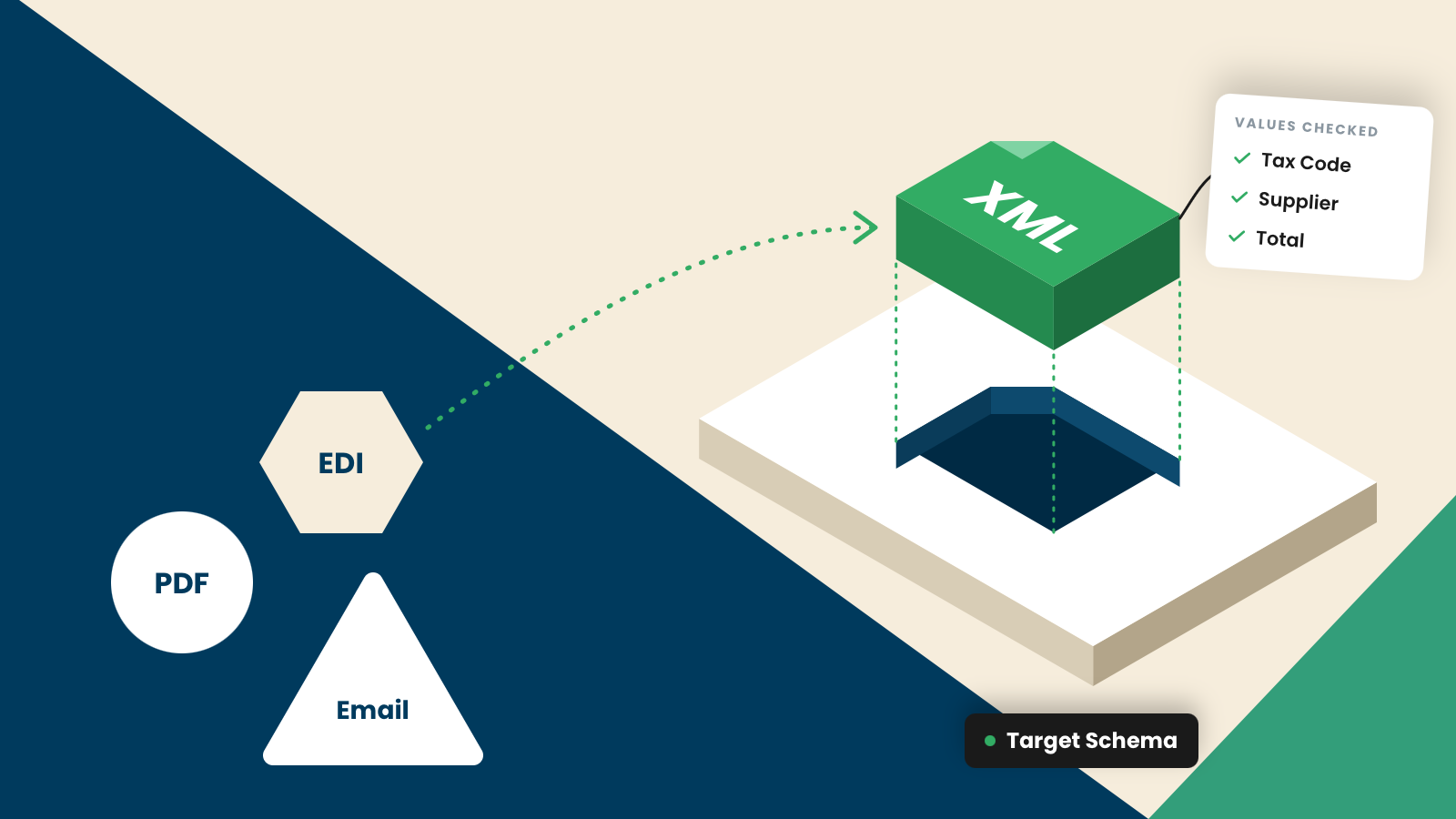
To automate XML mapping with AI, you use an AI platform to read a source document, match each field to the right element of a target XML schema, then transform and validate the data into schema-ready XML. Business teams configure this without code, and a person reviews only the exceptions.
This guide walks finance and operations teams through the practical path, step by step. You will see where AI removes the manual field-to-schema work, how to keep the output trustworthy, and what the 2026 to 2030 compliance calendar means for the documents your business sends and receives.
Why this matters now
For years, converting a document or a data feed into a specific XML format was slow, specialist work. Someone read each field, decided which element it belonged in, and rebuilt the map every time a supplier, a partner, or a schema changed. That approach no longer keeps pace, because structured XML is becoming mandatory rather than optional. EN 16931, the European e-invoicing standard set under Directive 2014/55/EU, already underpins national rules, and Germany now requires companies to receive e-invoices and, from 1 January 2027, to issue them in EN 16931-compliant XML for larger firms [3]. The EU's VAT in the Digital Age (ViDA) package, adopted on 11 March 2025, makes digital reporting and e-invoicing mandatory for intra-EU cross-border business from 1 July 2030 [2]. When the format is fixed by law and volumes keep rising, mapping by hand stops being sustainable.
What automating XML mapping with AI involves
At its core, XML mapping matches the fields in a source, an invoice, a sales order, an email, or an incoming EDI message, to the correct elements of a target XML schema, then transforms and validates the values so they conform. Computer scientists call this schema matching, and it is a genuinely hard problem.
Peer-reviewed research has long described schema matching as manual, costly, and error-prone, because the same idea is named and structured differently in every system [4]. AI changes the economics. Rather than reading each field and hand-building rules, an AI platform learns the correspondences from prior examples and proposes the mapping for you. The internal machinery deserves its own treatment, so this guide stays on the steps a team actually follows.
How to automate XML mapping with AI, step by step
A reliable rollout follows the same sequence, whatever documents you handle. Work through these six steps in order, and the project stays scoped, measurable, and easy to explain to the people who fund it.
1. Start from the target schema. Define the output first: the XML your systems or partners expect, whether that is a Peppol BIS profile aligned to EN 16931, a national format, an ERP import schema, or a trading-partner layout. List the mandatory fields and their rules before you look at a single source document.
2. Let AI read and interpret the source. Point the platform at real documents and data. Good AI reads for meaning, so a total registers as a total and a party as a party across varied layouts, rather than returning a wall of unlabeled text.
3. Let AI propose the mapping. The platform suggests how each source field maps to each target element, with a confidence score on every match. A person reviews the proposal once, corrects the edge cases, and that mapping is reused on every future document of the same type.
4. Validate against the schema and your rules. Conformance to the schema is the floor, not the finish. Check the values against your business logic and master data too: do the tax codes exist, does the supplier match a real record, do the line items reconcile to the total.
5. Route exceptions to a person. Send low-confidence or failing records to a reviewer through human-in-the-loop review, while clean records move ahead untouched as Straight-Through Processing. This is how you gain speed without gambling on unchecked output.
6. Connect and maintain. Deliver the validated XML to the destination, an ERP, a partner, or an e-invoicing network, and let the platform flag drift when a schema or a partner format changes, so the mapping keeps working over time.
Notice that no step asks a business user to write code. The configuration lives in a visual, reviewable setup, and the specialist effort shifts from building maps by hand to confirming what the AI proposes.
Where AI XML mapping pays off first
Some workflows return the effort faster than others. The strongest candidates are high in volume, bound to a fixed schema, and costly when a value is wrong.
•Accounts payable e-invoicing: turning incoming invoices into EN 16931-compliant XML for a Peppol network, where format errors are rejected at the door.
•Order to ERP: converting emailed or PDF purchase orders into the XML your ERP imports, so orders enter clean and on time.
•Partner onboarding: mapping a new trading partner's EDI or XML layout to your internal schema, which traditionally took weeks of specialist work per partner.
In each case the payoff is not only speed. It is fewer rejected documents, fewer downstream corrections, and a mapping that survives the next format change instead of breaking on it.
Getting it right: validation, compliance, and honest limits
Automation earns trust when it is honest about its edges. AI proposes mappings well, but a confident guess on an ambiguous field is more dangerous than a flagged one, so confidence scoring and human review stay part of the design rather than an afterthought. Treat the first weeks as a supervised ramp, not a switch you flip and forget.
Compliance raises the bar further. Where mapped data feeds a regulated decision, the workflow can fall inside a system a regulator treats as high-risk. Under the EU AI Act, the general provisions apply from 2 August 2026 and the obligations for high-risk systems under Article 6(2) and Annex III apply from 2 December 2027 [1]. Those duties cover data governance, documentation, and demonstrable human oversight. Build the audit trail and the review points in from the start, so you can show how any given value reached its XML element long before anyone asks.
A schema-valid file is not a business-valid file
Most treatments of this topic stop at producing well-formed XML that passes schema validation. That is the easy half. A file can conform perfectly to EN 16931 and still carry the wrong tax code, an unmatched supplier, or a total that does not reconcile. Schema validation confirms the shape; it says nothing about whether the values are true. The honest buying test is simple to state and hard to pass: does the platform validate the mapped data against your own business rules and master records before it reaches your ERP or an e-invoicing network, or does it hand you tidy XML that a person still has to check line by line? Everything that removes real manual work sits on the far side of that line.
How Docupath helps
Docupath is an AI-native document intelligence platform that reads, interprets, verifies, and validates documents into structured, system-ready data mapped to your target schema. Its AI Model Garden applies several specialized models per document and per field, and human-in-the-loop review handles the exceptions that warrant a second look. Clean records flow straight through, so your ERP or e-invoicing network receives validated XML with the audit trail regulated teams increasingly need.
Key Takeaways
•To automate XML mapping with AI, start from the target schema, let AI read and map the source fields, then validate the values before anything is sent.
•The work is no-code: business teams review what the AI proposes rather than hand-building maps, and specialist effort shifts to confirming edge cases.
•Validation is the point, not schema conformance. A file can be schema-valid and still business-wrong, so check values against your rules and master data.
•Structured XML is increasingly mandatory. EN 16931 underpins national e-invoicing rules and EU cross-border e-invoicing becomes mandatory from 1 July 2030 [2][3].
•In regulated workflows, build audit trails and human oversight in early: the EU AI Act's general rules apply from 2 August 2026 and high-risk Annex III obligations from 2 December 2027 [1].
References
- [1] European Parliament and Council, "Regulation (EU) 2024/1689 (Artificial Intelligence Act): Implementation Timeline," entered into force 1 Aug 2024; general provisions applicable 2 Aug 2026; high-risk obligations under Article 6(2) and Annex III applicable 2 Dec 2027. [Online]. Available: https://artificialintelligenceact.eu/implementation-timeline/ (accessed 23 Sep 2026).
- [2] European Commission, Directorate-General for Taxation and Customs Union, "VAT in the Digital Age (ViDA)," adopted 11 Mar 2025, in force 14 Apr 2025; digital reporting and e-invoicing for intra-EU cross-border B2B transactions applicable from 1 Jul 2030. [Online]. Available: https://taxation-customs.ec.europa.eu/taxation/value-added-tax-vat/vat-digital-age-vida_en (accessed 23 Sep 2026).
- [3] European Committee for Standardization (CEN), "EN 16931-1: Electronic invoicing - Semantic data model of the core elements of an electronic invoice," developed under Directive 2014/55/EU; referenced by Germany's Growth Opportunities Act (Wachstumschancengesetz) requiring EN 16931-compliant B2B e-invoices, reception from 1 Jan 2025 and issuance from 1 Jan 2027 for firms with turnover above EUR 800,000. [Online]. Available: https://ec.europa.eu/digital-building-blocks/sites/pages/viewpage.action?pageId=758743138 (accessed 23 Sep 2026).
- [4] E. Rahm and P. A. Bernstein, "A survey of approaches to automatic schema matching," The VLDB Journal, vol. 10, no. 4, pp. 334-350, Dec. 2001, doi: 10.1007/s007780100057.