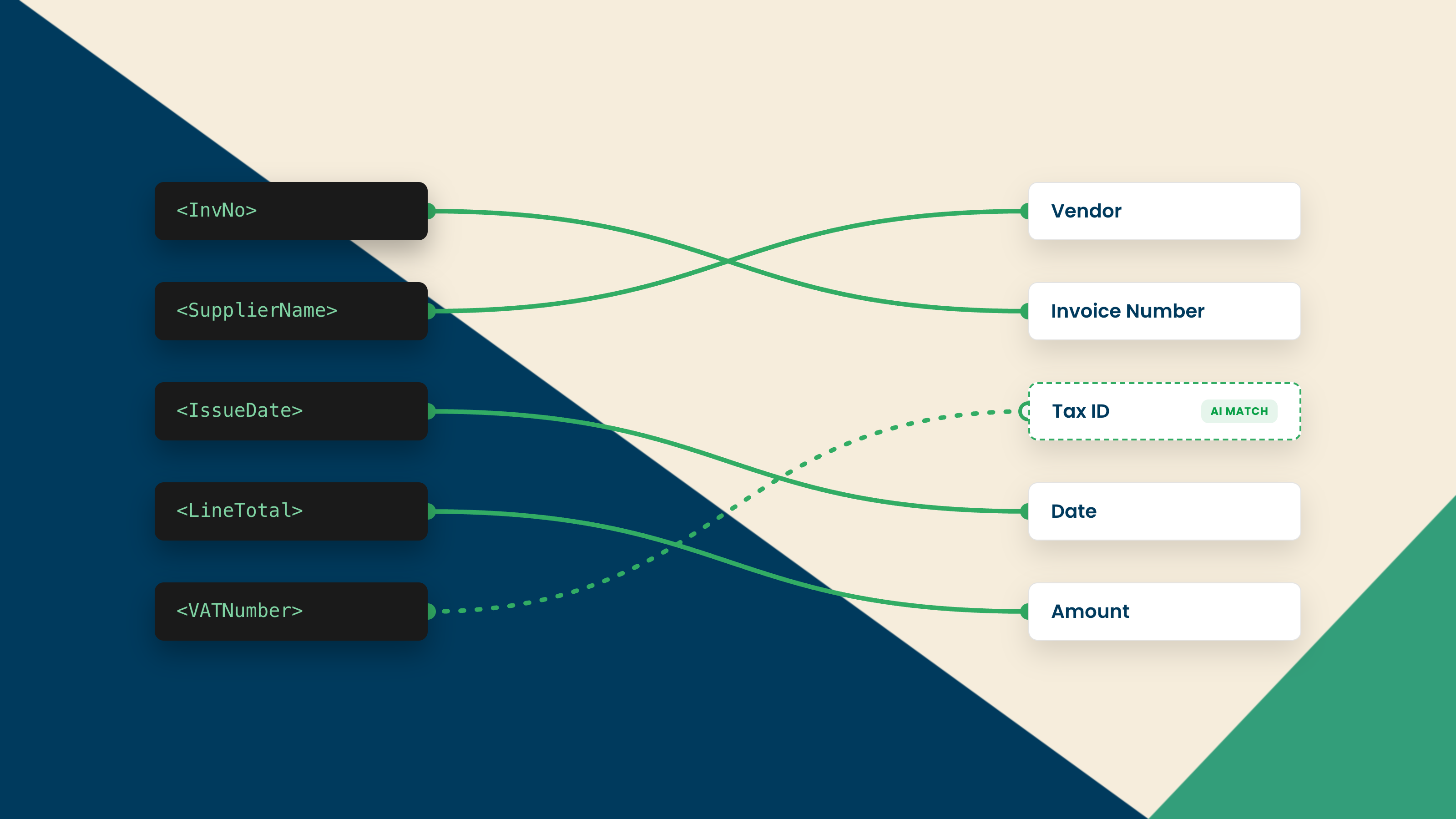
AI XML mapping tools use artificial intelligence to match data from a source document or system to the fields of a target XML schema, such as UBL or CII. They read schemas, propose mappings by meaning rather than exact field names, and generate the transformation, cutting the manual configuration mapping once demanded.
This guide is a buyer's map of the category. It explains what AI XML mapping tools do, the main types on the market, how to tell them apart, and why e-invoicing and EDI mandates are pushing the topic up the finance and operations agenda in 2026.
Why this matters now
For years, most business documents traveled as PDFs and paper, and someone on the receiving end retyped the numbers. That era is closing. Tax authorities and large buyers across Europe now require invoices and trade documents in structured formats, so the data has to arrive as valid XML that a receiving system accepts on the first try. Meanwhile trading partners each expect their own schema, and mandates keep the target moving. The practical result is a steady, unglamorous workload: taking data out of one system and shaping it to fit another's rules, over and over. AI XML mapping tools exist to carry that load, and the market around them is filling quickly with options that look alike and behave very differently.
What XML mapping is, and why it is hard
XML mapping is the work of translating fields from a source, a document, an ERP export, or another format, into a target XML schema so the receiving system accepts them. A total becomes the right element, a tax rate lands in the right node, and a line item nests correctly inside an order. When both sides agree perfectly, the job sounds trivial. They rarely agree.
Several things make mapping stubborn:
•Schemas are deep. Real formats carry nested and repeating structures, optional and conditional fields, data types, and value constraints that a plain field-to-field copy misses.
•Every pair is different. A mapping built for one partner or country often fails for the next, so teams maintain a separate configuration for each source and target.
•Formatting is unforgiving. Dates, currencies, and tax values must match the target's rules exactly, or the document is rejected and payment stalls.
•The rules move. When a standard or a mandate changes, every affected mapping needs revisiting.
This is why mapping has traditionally been slow, specialist work. It is also why AI has drawn so much attention here: much of the matching that consumed specialist time can now be proposed automatically, by meaning rather than by exact field name.
The AI XML mapping tool landscape
Search for a tool and the results blur together, because very different products wear the same label. Sorting them into categories makes a comparison possible.
Graphical mapping editors. Long-standing desktop and server tools let a specialist draw connections between a source and a target format. They are powerful and precise, but they were built for technical users and assume someone maintains each mapping by hand.
Integration and iPaaS platforms. Broader data-integration suites fold mapping into a wider pipeline that moves data between applications. Mapping is one feature among many, and depth on any single document standard varies.
Generic AI assistants. General-purpose models can draft a mapping or suggest code when prompted. They are quick for a first pass, but their output is probabilistic, unvalidated, and different from one run to the next, which is a poor fit for finance and tax data.
AI-native document intelligence platforms. Newer platforms read the source document or data, understand its structure, and produce validated, structured output mapped to the target schema. Because the input is already trustworthy, the mapping sits on solid ground.
The categories are converging in name but not in behavior. A graphical editor and a general-purpose chatbot both claim to map XML, yet one is deterministic and maintained by hand while the other is fast but unpredictable. The question that matters to a buyer is less about the label on the box and more about whether the output can be trusted without a person checking every run.
How to evaluate an AI XML mapping tool
Feature lists rarely settle a decision, because most tools claim the same headline abilities. A short set of buyer questions separates them faster than a demo does.
What to check | Why it matters | Strong sign |
|---|---|---|
Schema understanding | Real schemas carry nested and repeating structures, optional and conditional fields, and value constraints | Reads the schema and proposes mappings by meaning, not exact field names |
Deterministic output | Finance and tax data must be identical every run; probabilistic output cannot be trusted in production | he same input always produces the same output, with no drift |
Built-in validation | A mapped field can still be wrong, and rejected e-invoices delay payment | Validates against the target schema and your own rules before data is sent |
Auditability | Regulators and auditors ask how a figure was produced | Every transformation is reproducible, testable, and traceable |
Standard coverage | Trading partners and countries use different formats | Supports the XML invoice syntaxes you use, such as UBL, and aligns with the EN 16931 semantic standard |
Maintenance model | A mapping per system pair does not scale | A canonical model connects each format once |
Two of these carry the most weight for regulated work. Deterministic output means the transformation behaves the same way every time, so an auditor sees a repeatable process rather than a model's best guess. Built-in validation means errors surface before a document leaves your systems, not after a partner rejects it. A tool that maps quickly but cannot promise either will move work around rather than remove it.
The regulatory backdrop across markets
The reason this category is heating up is regulatory, not fashionable. Structured e-invoicing is becoming mandatory across much of Europe, and each market maps to its own target.
In the EU, the VAT in the Digital Age (ViDA) package will require structured electronic invoicing for cross-border business-to-business transactions under Digital Reporting Requirements from 1 July 2030 [1]. Sweden has gone further at home: public-sector e-invoicing has been mandatory since 1 April 2019, using Peppol BIS Billing 3 [2]. Germany requires businesses to receive structured e-invoices, with issuance obligations phasing in over the following years, in formats such as XRechnung and ZUGFeRD. Denmark, Norway, and Finland each route public procurement through Peppol-aligned formats. The United Kingdom follows a principles-based path, yet any UK firm trading into the EU inherits these requirements.
Governance adds a second reason to care about how a tool behaves. Where an AI-assisted transformation feeds a regulated decision, it can sit inside a high-risk system under the EU AI Act, whose main obligations apply from 2 August 2026 and whose high-risk duties under Annex III apply from 2 December 2027 [3]. Audit trails and deterministic behavior stop being nice-to-haves and become part of the buying criteria.
Proposing a mapping is easy; trustworthy output is the test
Most of this market competes on how quickly it can propose a mapping. That contest is close to settled, because matching a source field to a target element is becoming easy. The open problem is trust. A proposed mapping is not a verified one, and a fast transformation that drifts between runs cannot support a tax filing or an audit. The tools that earn their place make the output deterministic, validate it against the target schema and your own rules and records, and keep a trail an auditor can follow. That is the honest test, and it is the one most tool pages avoid.
How Docupath helps
Docupath is an AI-native document intelligence platform that reads, interprets, verifies, and validates documents into structured, system-ready data. Its Atlas capability reads your schemas and proposes mappings by meaning, then compiles them into deterministic transformations that behave the same way every run, with validation and an audit trail built in. Because the data being mapped is already validated, what reaches your ERP, tax platform, or trading partner is dependable, not a best guess.
Key Takeaways
•AI XML mapping tools match data from a source document or system to a target XML schema such as UBL or CII, proposing mappings by meaning rather than exact field names.
•The market splits into graphical editors, integration platforms, generic AI assistants, and AI-native document intelligence platforms, which behave very differently despite similar claims.
•For finance and tax work, deterministic output and built-in validation matter more than raw speed: the same input should always produce the same, checkable result.
•Mandatory structured e-invoicing is the main driver. The EU's ViDA rules reach cross-border B2B from 1 July 2030 [1], and Sweden has required public-sector e-invoicing since 2019 [2].
•Where mapping feeds a regulated decision, build in audit trails and deterministic behavior ahead of the EU AI Act's high-risk obligations on 2 December 2027 [3].
References
- Taxation and Customs Union, "VAT in the Digital Age (ViDA)," Official Journal of the European Union under the L-series, 2025. Available online
- The National Agency for Public Procurement (Upphandlingsmyndigheten), "Mandatory e-invoicing in the public sector," The National Agency for Public Procurement (Upphandlingsmyndigheten, n.d. Available online
- European AI Office, "Implementation Timeline," Artificial Intelligence Act, 2024. Available online